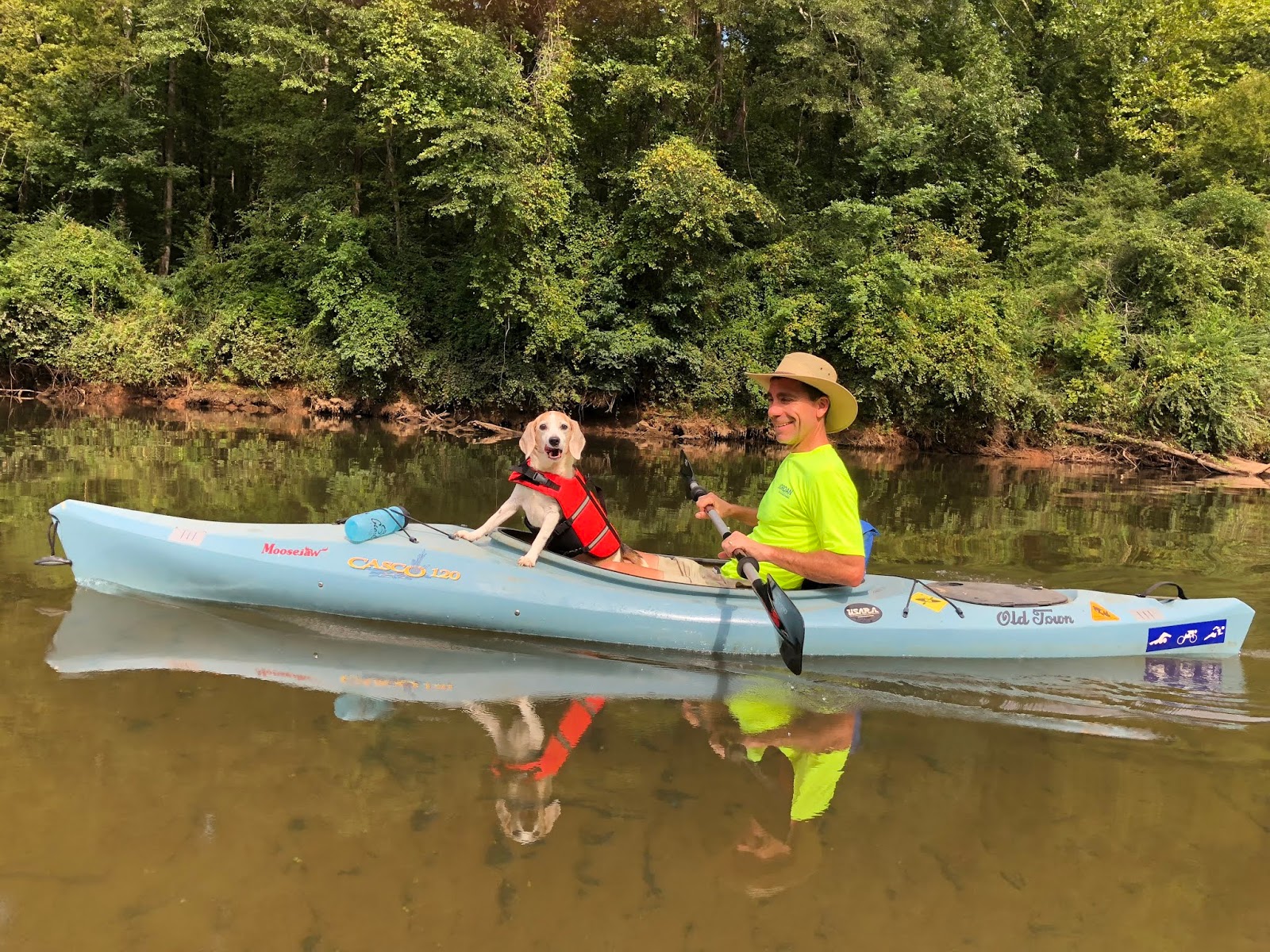
A few months ago, we started discussing where we might go. We decided on the beach because we haven’t been there in a long time. But which beach? We considered everything from Baja California (not conducive to road biking) to somewhere along the Gulf coast. Finally, we decided to visit Georgia’s barrier islands, which are relatively close.
The Atlanta-Journal Constitution did an excellent series of articles on Georgia’s barrier islands a few years ago. I remembered reading about how varied they are in their accessibility, available activities, etc. After some research, we decided to spend a couple of nights each on Little St. Simons Island and Jekyll Island. It was an interesting juxtaposition. (Heh heh - juxtaposition. One of my favorite words.)
Georgia's barrier islands include eight major islands/island groups. They formed over a number of centuries because of wind, tides, and sedimentation. They protect the mainland from hurricanes and other major storms. Georgia is further protected from such storms because of its position in the South Atlantic Bight, a significant inward curving of the shoreline along the Atlantic coast.
Little St. Simons Island and Jekyll Island have similar geology and physiography, but when it comes to vacationing there, they are like night and day.

Soon Kelly returned and took Robert and me and two others to our cottage. It had four bedroom/bathroom units and an inviting common area with a fireplace, sink, mini refrigerator with plenty of Cokes, and a screened-in porch. There were even books and board games.


Nate transported our group with kayaks to the South End Launch. It was just beautiful there.


We saw the manatees again! They were right near our launch point. We think they were the same ones we had seen the previous afternoon.
Nothing is more relaxing than paddling, and it was an extra special treat to get to paddle through the marshes.


Little St. Simons Island and Jekyll Island have similar geology and physiography, but when it comes to vacationing there, they are like night and day.
Little St. Simons Island
I loved Little St. Simons Island. It’s like an all-inclusive state park. There are all kinds of outdoor activities and
opportunities to learn about the island’s uniquely beautiful ecosystem. At the same time, the accommodations are rustically
plush, and the food is outstanding. Beer
and wine are even included in the price.
It’s like someone tailor-made this vacation destination for me. Robert said we’re luxurious ruffians.
Little St. Simons Island is accessible only by boat from St.
Simons Island. Robert and I headed out
from home at o’dark thirty on a Wednesday morning for the 10:30 AM ferry to
Little St. Simons. Most of the other
guests were transported on a small boat. Robert and
I were led to an even smaller skiff – fun!
I generally stay very busy at work, and it’s always a
scramble to tie up loose ends before going on vacation. I was still pretty tense when we arrived at the marina. However, Little St. Simons Island began
working its magic on me immediately. As we made our way down the Hampton River toward the island, the stress started melting away as I felt the
wind in my hair and the sun on my face.
After about 20 minutes, we arrived at Little St. Simons
Island. Kelly, the office manager, greeted us. She and all the Little St. Simons Island
staff were extremely friendly and helpful.
Kelly gave our group a brief orientation and then started showing us to
our rooms. While she took the first few
guests to their cottage, Robert and I looked in the museum at the Lodge. I was happily surprised to see that Little
St. Simons is a UNESCO site.

Soon Kelly returned and took Robert and me and two others to our cottage. It had four bedroom/bathroom units and an inviting common area with a fireplace, sink, mini refrigerator with plenty of Cokes, and a screened-in porch. There were even books and board games.
We had time for an outing before
lunch. Nate, one of the naturalists on
staff, loaded a group of us into the back of a pickup truck that had viewing
benches. First, we went to Goose Pond. Right away we got a taste of the exquisite wildlife on Little St. Simons. Several species of birds congregated at the end of the pond. I was especially excited to see roseate spoonbills, beautifully distinctive birds. They are pink because of the beta carotene in the shrimp they eat. They also have distinctive spoon-shaped bills - hence, the name roseate spoonbill.
We also saw - count them - 31 alligators! Mostly we just saw eyes and tips of snouts poking out of the water. Nate explained that these were fairly young alligators. Alligators keep growing as they age. When a male alligator gets large enough, it takes over a territory and drives out other alligators. Nate also described how an alligator's lungs are fairly mobile within its chest cavity. The alligator can inhale or exhale to adjust its buoyancy.
Next we made a brief stop at Norm's Pond. Norm is a very large alligator that claims this pond for his own because it's a prime spot. Although we didn't see him, we did see a number of wading and marsh birds.
It was time to head back to the Lodge for lunch. Every meal we had on Little
St. Simons was excellent. They have a
chef, and much of the produce is grown right there. That first lunch included homemade
cheeseburgers and French fries, some kind of delicious salad with cauliflower
and pesto, and freshly baked cookies.
Each morning and afternoon have a choice of two
activities led by naturalists. Alternatively, you can do
whatever you like on your own, whether it’s fishing, cycling, taking out a
skiff, or going to the beach. They’ll
even pack you a picnic lunch if you want to stay out all day. I wonder if the picnic lunches are as
delicious as the regular lunch at the Lodge?
Probably.
On our first afternoon on Little St. Simons, Robert and I
opted for the excursion to the north end of the island. It was a fairly big group, and so we split
between two trucks. Nate took one group. John, another staff naturalist, took the
other group, which included Robert and me.
As we rode through the maritime forest, John filled us in on
some of the Little St. Simons’s recent history. He started with Pierce Butler, who owned the island in the late 1700s and used it for a rice plantation. In the early 1900s, the Engle Pencil Company bought the island because of the numerous cedar trees, the preferred wood for making pencils. However, the trees were too twisted by the coastal elements to be suitable for pencils. Meanwhile, Philip Berolzheimer, the president of Engle Pencil Company became enchanted by Little St. Simons and purchased it for his own personal retreat. In 1979 the island was first opened to the public. Henry Paulson, former U.S. Treasury Secretary, and his wife Wendy bought a majority interest from Berolzheimer's descendants in 2003. Since then, the owners of the island have donated a conservation easement to The Nature Conservancy to permanently protect Little St. Simons Island. How fortunate for us!
There's so much to learn about the natural world that it can be overwhelming. I like to focus on one or two tidbits from each experience, which seems to help me retain information over time. John taught me how to differentiate between several common wading birds that are white: the great egret, the snowy egret, and the white ibis. The great egret is the largest of the three birds, but that doesn't always help if the other two species aren't also there. Therefore, the better distinguishing feature is its distinctive yellow bill. The snowy egret has a black bill and black legs. Finally, the white ibis has a red bill that curves downward. Once I learned these different traits, I easily identified the species of the white birds I saw the rest of our time on Little St. Simons.
We stopped at North Pond. We saw an alligator nest and then, out in the water...baby alligators! They were a few months old and only about a foot long each. Then, someone in our group spied mama alligator. The top of her head and tip of her snout were just peeking out of the water.
Next was a stop at River Beach. We could see Egg Island and Little Egg Island across the Altamaha River. These islands are even more secluded than Little St. Simons Island. At River Beach, hundreds of fiddler crabs scurried across the sand near the spartina (cordgrass).

We stopped at North Pond. We saw an alligator nest and then, out in the water...baby alligators! They were a few months old and only about a foot long each. Then, someone in our group spied mama alligator. The top of her head and tip of her snout were just peeking out of the water.
Next was a stop at River Beach. We could see Egg Island and Little Egg Island across the Altamaha River. These islands are even more secluded than Little St. Simons Island. At River Beach, hundreds of fiddler crabs scurried across the sand near the spartina (cordgrass).
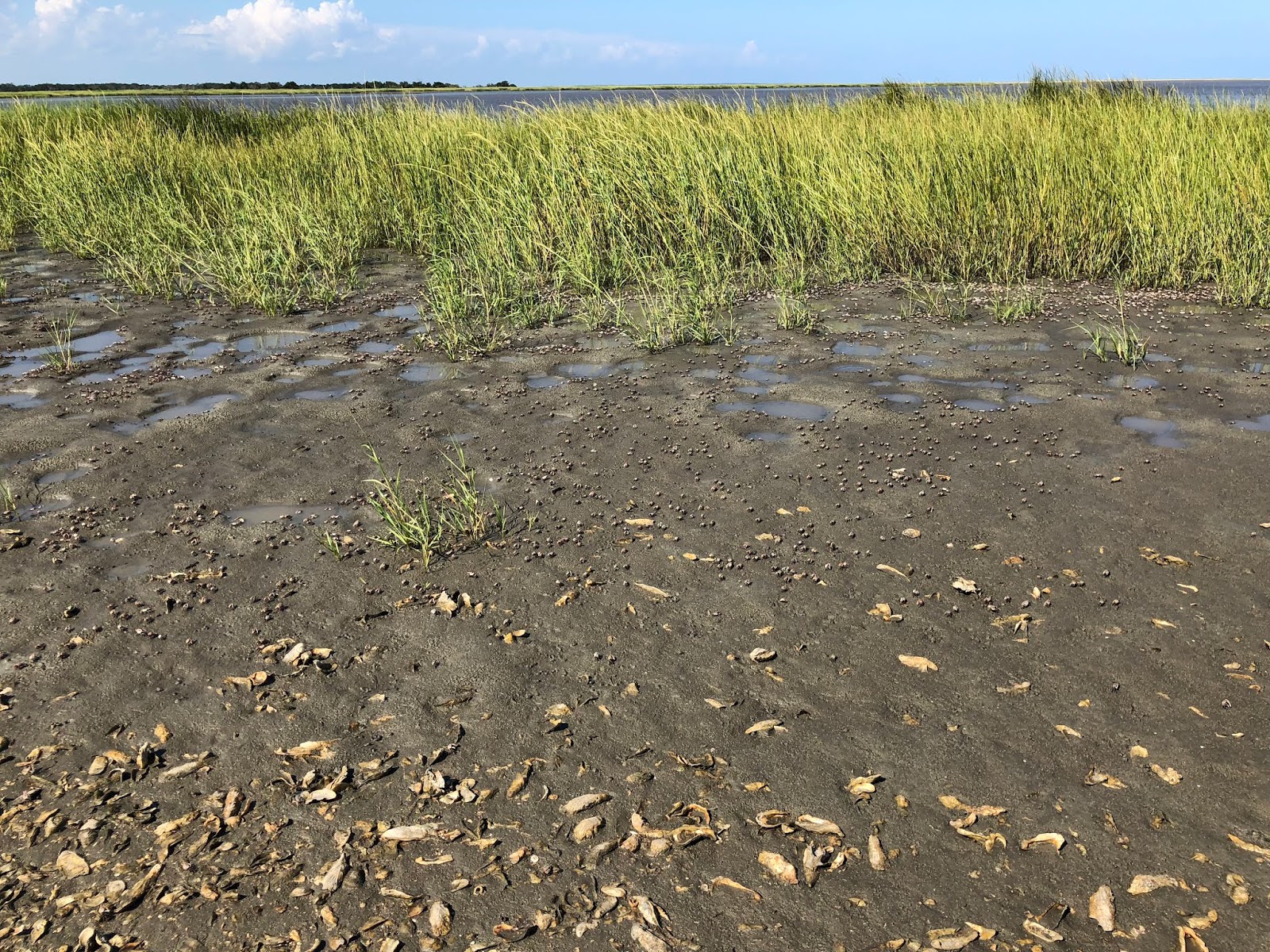
John picked up a couple of the fiddler crabs so that we could see the difference between a female and a male.
A bigger claw on a male is generally more attractive to females. However, the bigger the claw, the more slowly the male moves. This is a typical evolutionary trade-off that helps explain individuation within a species.
John loaded the group up again to head southward. While we were driving, Nate radioed John to tell him that Nate's group had seen manatees! However, they were already gone. Bummer.
Our group then went to Barge Landing for more wildlife viewing along Mosquito Creek and simply to relax at a beautiful spot. John was about to take us to one more site (the island airstrip), when we got word that the manatees were at the dock! We hightailed it over there. We saw them!

Several staff naturalists were at the dock. They counted five manatees and surmised that four males were pursuing a female. One of the naturalists said that they have only a few manatee sightings a year, and so we were especially lucky to have this experience!
 |
| Female on the left in the photo, male (big claw) on the right in the photo |
A bigger claw on a male is generally more attractive to females. However, the bigger the claw, the more slowly the male moves. This is a typical evolutionary trade-off that helps explain individuation within a species.
John loaded the group up again to head southward. While we were driving, Nate radioed John to tell him that Nate's group had seen manatees! However, they were already gone. Bummer.
Our group then went to Barge Landing for more wildlife viewing along Mosquito Creek and simply to relax at a beautiful spot. John was about to take us to one more site (the island airstrip), when we got word that the manatees were at the dock! We hightailed it over there. We saw them!

Several staff naturalists were at the dock. They counted five manatees and surmised that four males were pursuing a female. One of the naturalists said that they have only a few manatee sightings a year, and so we were especially lucky to have this experience!
As we headed back from the dock toward the Lodge Compound, I stopped to take a photo of
the living shoreline.

A living shoreline is a more natural form of erosion control than a hard barrier such as a seawall. Comprised of native grasses and bags of oyster shells, a living shoreline maintains a connection between the creek and the upland. It provides both erosion control and habitat for live oysters, fish, and other creatures. The Georgia Department of Natural Resources has several thousand feet of living shorelines on several of the state's barrier islands.
I was tired from accumulated work fatigue as well as the day's wonderful activities. I had time for short nap before dinner. The screened porch at our cottage had a super comfortable sofa that was perfect for catching a few z's.
the living shoreline.

A living shoreline is a more natural form of erosion control than a hard barrier such as a seawall. Comprised of native grasses and bags of oyster shells, a living shoreline maintains a connection between the creek and the upland. It provides both erosion control and habitat for live oysters, fish, and other creatures. The Georgia Department of Natural Resources has several thousand feet of living shorelines on several of the state's barrier islands.
I was tired from accumulated work fatigue as well as the day's wonderful activities. I had time for short nap before dinner. The screened porch at our cottage had a super comfortable sofa that was perfect for catching a few z's.
Each evening a staff naturalist hosts cocktail hour from 6:00 to 7:00 PM. That evening the naturalist was Rock, and the hors d'oeuvre was a corn and tomato salsa, featuring ingredients grown on the
island. This was also one of the best times to visit with the other guests. It was such a nice group of people. It included a mother and daughter from Augusta, a semi-retired couple from Rome (GA), and a large group of siblings with spouses who take a trip together every year.
The Little St. Simons Island chef created an excellent dinner that night: salad, lamb shanks, mushroom risotto, brussels
sprouts, and individual lemon lava cakes. Following dinner, Rock presented the evening program, in which he dissected an owl pellet. We could see remnants of what the owl had eaten, like tiny vertebrae from a mouse.
After a restful night's sleep, Robert and I walked around the Lodge Compound before breakfast. We saw E the armadillo.

Nate had explained that nine-banded armadillos are a non-native but not really invasive species on the island. Wildlife biologists are studying them. A female armadillo always gives birth to four identical quadruplets, the result of a single egg splitting twice. Several months ago, baby armadillos A, B, C, and D were born. Then, the staff found E and F from another mother.

Nate had explained that nine-banded armadillos are a non-native but not really invasive species on the island. Wildlife biologists are studying them. A female armadillo always gives birth to four identical quadruplets, the result of a single egg splitting twice. Several months ago, baby armadillos A, B, C, and D were born. Then, the staff found E and F from another mother.
Time for breakfast. At home I eat oatmeal almost every morning. With this being vacation, I decided to mix it
up a little and partake of the spectacular breakfast array: fried eggs, chicken
and apple sausage, potatoes, fruit, and croissants. Several homemade preserves were served
alongside the croissants. One of them
turned out to be my favorite thing I ate on the whole trip – blueberry
preserves with smoked tarragon. I have
no idea how one would smoke tarragon or think to put it in blueberry preserves,
but it was simply delicious. Of course,
there was coffee (Robert happy) and a selection of teas (me happy). Other available items were homemade granola
and steel-cut oatmeal. I wish I could
have sampled it all.
At the end of breakfast, Rock told us about the morning’s
activity options. One was kayaking –
yea! Kayaking was one of my must-do items
while on Little St. Simons Island. A
little while later, we kayakers met up with Katie, yet another staff
naturalist, and Nate to be transported to the south end of the island. The plan was to paddle one-way on Mosquito
Creek back to the Lodge, mostly going with the tide.
While we were waiting to load up, Robert and I checked out
the beach cruisers in anticipation of the ride we planned for that afternoon.

And I saw the cutest baby racoon in the spartina! It wasn't very scared of us humans.

Nate transported our group with kayaks to the South End Launch. It was just beautiful there.


We saw the manatees again! They were right near our launch point. We think they were the same ones we had seen the previous afternoon.
Nothing is more relaxing than paddling, and it was an extra special treat to get to paddle through the marshes.

We paddled for a couple of hours and arrived back at the Lodge for lunch. It was another delicious one: grilled turkey and cheese
sandwiches, gazpacho, potato salad, and more freshly baked cookies (oatmeal craisin
this time).
Besides kayaking, the other activity I definitely wanted to
do while on Little St. Simons was go for a bicycle ride. That afternoon Robert and I headed out on
beach cruisers for some exploring.
First, we headed to the north end of the island, which we had visited
the previous day.
The dirt road through the maritime forest was shady and
pleasant. When we got to the marshy area
to the north, the going wasn’t so easy.
We had to navigate a number of patches of deep sand. Robert was able to ride through them, but I
had to walk my bike. I was huffing and
puffing, and my coating of bug spray was barely keeping the mosquitoes at
bay. But it was a good workout, and it
became more fun once we turned onto Marsh Road, where the ground became much
more ridable.
Marsh Road was beautiful and peaceful. We could see evidence of an earlier shoreline next to a treeline. Later, we found out that this shoreline dates to the Civil
War era. Little St. Simons Island has grown seaward by accretion, or the deposition of sediment. The rate of accretion has greatly acceleration since the arrival of European settlers. This is because they started farming on a large scale. Large quantities of sediment from farming and timbering have washed down the Altamaha River, which empties into the Atlanta Ocean next to Little St. Simons Island.
We also saw an unusual deer.
At first, I thought it was albino, but then I saw that it was mostly
white with some brown markings (piebald).
It was stockier than a whitetail.
Robert thought it looked a little sheep-like. Later we learned that we had seen a
Eurasian fallow deer, a species that was imported by Berolzheimer in the early 1900s for
hunting. In fact, this deer figures prominently in the logo of Little St. Simons Island:

The ducks represent the "Eight Bandits," a group of prominent New York policymakers who joined Berolzheimer for getaways on Little St. Simons Island.
The Eurasian fallow deer thrived so much that it drove out the native whitetail deer. In more recent years, biologists have determined that the island’s carrying capacity of the fallow deer is about 30. The population has been managed to maintain that number, and whitetail deer have reappeared, swimming across the channel from a neighboring island, St. Simons and/or Egg Island. Did you know that whitetail deer are excellent swimmers?

The ducks represent the "Eight Bandits," a group of prominent New York policymakers who joined Berolzheimer for getaways on Little St. Simons Island.
The Eurasian fallow deer thrived so much that it drove out the native whitetail deer. In more recent years, biologists have determined that the island’s carrying capacity of the fallow deer is about 30. The population has been managed to maintain that number, and whitetail deer have reappeared, swimming across the channel from a neighboring island, St. Simons and/or Egg Island. Did you know that whitetail deer are excellent swimmers?
Robert and I then rode to the beach. Katie was there, waiting until pickup time
for the afternoon beach group. He and I
gratefully got some water and then went for a dip in the ocean. Ahh…how refreshing! The group was gone by the time we got
out. As I put my clothes back on over my
bathing suit, I found that they were soaking wet. I hadn’t realized just how drenched with
sweat I had gotten from the bicycle ride.
Robert rode behind me as we pedaled back toward the
Lodge. I reflected contentedly about
what a wonderful day it had been. All of
a sudden, Robert started cussing up a storm.
What in the world?! Was he having
a heart attack? No, it was a huge Eastern
diamondback rattlesnake!
The rattler was at least five feet long. Unknowingly, I had ridden within a few feet
of it. It didn’t act aggressively toward
us all, but we still made sure to keep plenty of distance from it.
We got cleaned up back at the cottage, and soon it was time
for cocktail hour, hosted by Nate. That evening’s hors d’oeuvre
was sweet potato green dip. When I read
the description on the day’s menu, I thought it was going to be mashed sweet
potatoes with something green in it.
However, it turned out to be a cheesy dip with greens from the sweet
potato plant – fascinating and delicious! (and also from the island garden)
It would be hard for me to pick a favorite meal during our
vacation, but that evening’s dinner may have been it. We had perfectly cooked thick pork
chops. I like pork chops fine but don’t
go out of my way to order them. That
just goes to show how good these were.
We also had an excellent salad with flash-pickled radishes. The radishes were from the garden. The flash pickling took about 24 hours and
involved heated vinegar and spices. I
think we had two other vegetables. Maybe
the butternut squash was so good that it makes me forget what the other one
was. The chef told us how he cooked it:
roast the butternut squash; scoop out the flesh; and mix it with cream, lemon
juice, and salt. I can hardly wait to
try this at home. Oh, yeah – we had mini
pound cakes with berries for dessert!
For that evening’s program, we went to the barn. Nate let us meet Mr. King the king
snake. Mr. King is a retired 4H snake,
and so he’s used to being handled. We
all got a chance to hold him.

Mr. King’s reward for being such a good presentation snake
was three mice (not live). Whoa! It was amazing to watch him eat them whole.
The next morning, I took a brief walk before breakfast,
savoring our final hours on Little St. Simons Island. We had one more delicious island meal, and then Robert and I took a last walk around the Lodge Compound.
There are so many places in the world that
I’d like to see, but I loved Little St. Simons Island so much that it’s one of
the few places that I definitely want to visit again.

 |
| Decorative and functional roof drain that also prevents erosion |

Jekyll Island
Although I was sad to leave Little St. Simons Island, we had
phase two of our vacation to look forward to.
Once back on the mainland, Robert and I began the 45-minute drive to
Jekyll Island.
Jekyll Island is a favorite destination of a lot of people I
know. When I was around five to seven
years old, my family visited Jekyll a handful of times. I remember enjoying going to the beach but
don’t remember many details. Then, a few
months ago, I made a brief trip to the coast for some continuing education
classes. The classes were based in St. Marys,
but we did spend one afternoon on a beach ecology walk on Jekyll. It was wonderful but not long enough to get
much of an overall sense of the island. I
looked forward to spending time there with Robert.
The first place we visited when we got to Jekyll Island was
the Georgia Sea Turtle Center. I enjoyed
it very much. It has a number of
interactive stations and a video center where you can learn about the plight of
the world’s seven sea turtle species.
The number of sea turtles of all species has declined dramatically in
the past 50 years, particularly in the past 10 years. Sea turtles are a keystone species of the
oceans; as they suffer or become extinct, numerous other species are critically
harmed. One of the best ways to protect
sea turtles and other marine life is to reduce your use of disposable plastics,
e.g., straws and plastic shopping bags.
At the Georgia Sea Turtle Center, you can also watch as veterinarians
perform surgery on turtles, both land and water species.
That afternoon Robert and I went for a ride. We decided to ride around Jekyll Island
rather than go back to the mainland. A
lap around Jekyll is about 14.5 miles. We
completed two laps, making a decent vacation-style ride.
I was ready for some seafood that evening. We ate at Eighty Ocean, a restaurant at the
Jekyll Ocean Club where we stayed. It
was pretty good.
The next morning Robert and I walked on the beach and then headed
to the historic area of Jekyll Island, which is on the inland side. After a tasty breakfast in a coffee shop
adjacent to the historic Jekyll Island Club Hotel, we went on a guided historic
tour. A trolley transported a fairly
large group of us tourists among the “cottages” where some of the richest
Americans spent their winters in the late 1800s and early 1900s. Members of the Jekyll Island Club had their
own living quarters, but the club agreement required them to take all their
meals in the common dining room. It’s
estimated that when the Jekyll Club assembled for meals, approximately 1/6 of
the world’s wealth was in one room together.
Interestingly, members of the Jekyll Island Club came up
with the Federal Reserve during their time on the island.
By the Jekyll Club members’ standards, their “cottages” were
roughing it. It still was quite swanky though,
especially considering the numerous servants they had. I told Robert that I would have felt guilty
about living as high on the hog as the Jekyll Club members did while all the
servants waited on them. He responded
that I feel guilty about everything.
True. I would have made a good
Catholic.
One other note about the historic area of Jekyll Island: the Georgia Sea Turtle Center is housed in the old power generating building from the Jekyll Club days. What a great way to repurpose the building!
Robert and I made a couple more laps around Jekyll Island on
our bicycles that afternoon. Then, we
went for a swim in the ocean. The sand
where we waded out was much stickier than the ocean sand on Little St. Simons
Island. Even so, I really enjoyed the
calming rhythm of the ocean waves as I relaxed in the water.
That evening it was time for more seafood, this time at The
Wharf, back in the historic district. I
had made our reservation for 6:30 PM, the perfect time to watch the sunset as
we dined outside. I enjoyed the Wharf
Boil, a variation on Low Country boil.
In addition to shrimp, corn, and new potatoes, the Wharf boil also had
clams and crab legs. Good eats.
On our final morning, I went for one last beach walk.

Although Jekyll Island hadn’t fed my soul the
way Little St. Simons Island had, I was still sad to see my time at the coast
coming to an end. I hope I can return to
Georgia’s barrier islands soon.